As part of the Stop Killing Games campaign Gamers’ Voice joined Stop Killing the Internet, the Internet Archive Europe and digital rights campaigners in Brussels to challenge proposals for age verification, online restrictions and digital identity checks that could threaten the rights of gamers and internet users across Europe.
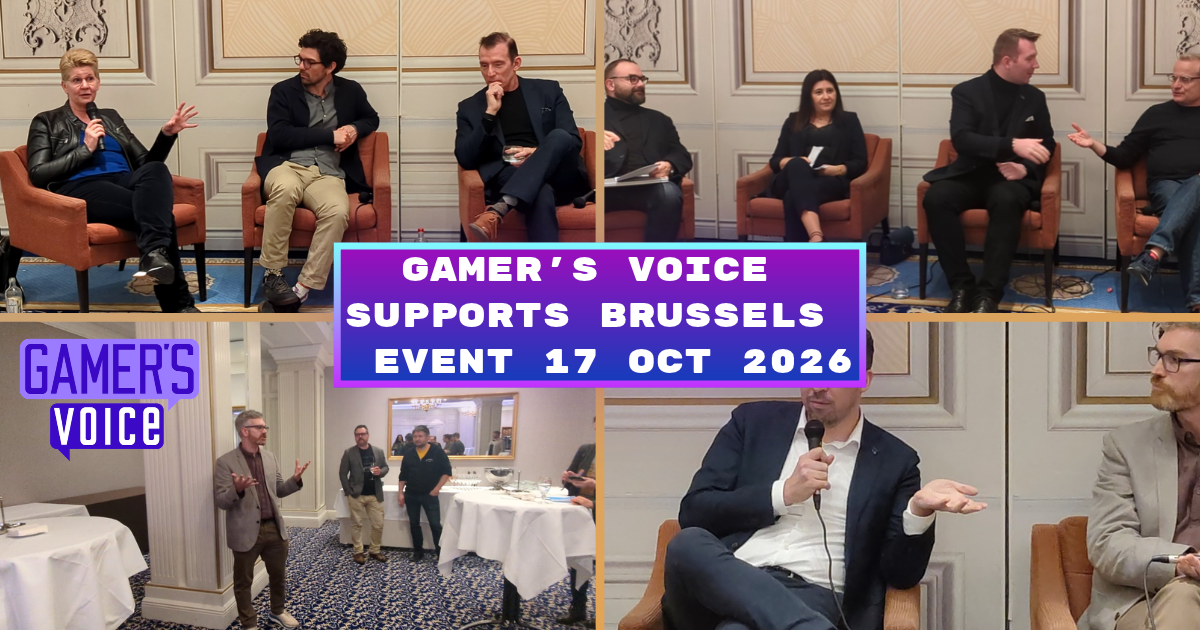
On Saturday 17 October, Gamers’ Voice helped organise and host a major discussion on the future of online freedoms in Europe, bringing together digital rights campaigners, cybersecurity experts and policy specialists at the Steigenberger Wiltcher’s Hotel in Brussels.
The event, Fair Play in the Digital Fairness Act, examined the European Union’s plans for regulating online services, including proposals under the EU KIDS Act, and the potential consequences for privacy, freedom of expression and access to online communities around the world.
As the UK chapter of Stop Killing Games and a founding supporter of the international Stop Killing the Internet movement, Gamer’s Voice has been working to ensure that the interests of gamers are represented in debates about the future of the internet.
Why this matters for gamers
Online gaming is about far more than playing games. Multiplayer communities, private servers, forums, streaming platforms and social spaces have become an important part of how millions of people connect, make friends and participate in shared cultural experiences.
But proposed restrictions on online services risk undermining these communities.
Gamers’ Voice believes that protecting children online should not mean making the internet less accessible, less private or less secure for everyone.
Protecting children without restricting everyone
Throughout the Brussels discussion, speakers challenged the assumption that restricting access to online spaces necessarily makes children safer.
James Baker, co-founder of Gamers’ Voice, a founding member of Stop Killing the Internet and Platform Power Manager at the Open Rights Group, warned that broad restrictions could have unintended consequences.
“When you close a digital space, people do not disappear. They move. The result is an internet that fractures back into less supervised corners, some online, some in the real world, and many of them more harmful than the places that were closed.”
Speakers argued that measures intended to protect children must be supported by evidence, respect fundamental rights and satisfy the principles of necessity and proportionality.
The debate also highlighted the importance of online communities for young people who may struggle to find friendship, support or opportunities to socialise offline.
For many gamers, particularly those who are isolated or face barriers to participation in their local communities, online gaming provides valuable opportunities for connection and belonging.
Blanket restrictions risk removing these benefits without addressing the underlying causes of online harm.
Making platforms safer, not putting up barriers
Rather than focusing primarily on restricting access, speakers called for greater attention to the design of online platforms and the business practices that contribute to harmful experiences.
This includes examining how recommendation systems operate, how platforms encourage prolonged engagement and how business models based on extensive collection of personal information can create harmful incentives.
Baker argued that policymakers should focus on improving the services people use.
“So why don’t we look at how we can actually change the platforms themselves?”
For Gamers’ Voice, this approach is particularly important.
Gaming platforms should provide meaningful user controls, effective moderation tools and appropriate options for parents without unnecessarily restricting adults or excluding young people from legitimate gaming experiences.
Measures must also recognise the diversity of the gaming ecosystem. A small community-operated game server is not the same as a major social media platform, and regulations should reflect those differences.
Gamers’ Voice and Stop Killing the Internet
Helping to put on the Brussels event forms part of Gamers’ Voice’s growing international work to defend gamers’ rights and protect access to online spaces.
Through our involvement in both Stop Killing Games and Stop Killing the Internet, we are campaigning for a future in which games remain playable, online communities remain accessible and people can enjoy digital culture without unnecessary surveillance or restrictions.
The Brussels discussion demonstrated that concerns about age verification and online restrictions extend well beyond the gaming community. They raise fundamental questions about privacy, autonomy and the sort of internet future generations will inherit.
Protecting children and protecting fundamental rights should not be competing objectives.
Gamer’s Voice will continue to work with gamers around the world to ensure the things we love to enjoy are protected.
Leave a Reply
You must be logged in to post a comment.